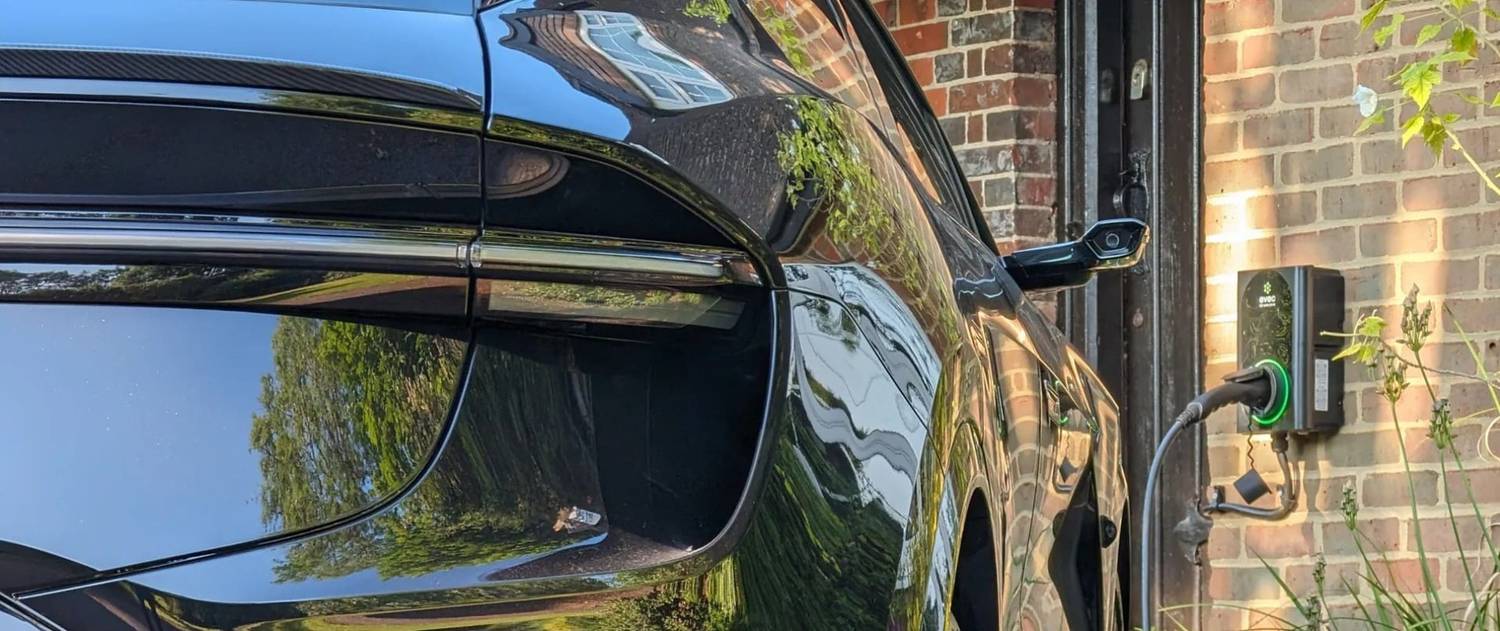
EVEC EV Charger Installation Guide UK
If you’re debating whether or not to get EVEC EV charger installation, then the following guide will help.
We’ll go into detail about the different EVEC EV charger types and how they’re installed. You’ll understand the prices, electrical requirements, installation process, compliance rules, and any potential grants that are available.
By reading this, you’ll be able to inform yourself on whether installing such a charger fits your EV charging requirements and infrastructure goals.

What Does EVEC Offer?
EVEC’s ranges focus on smart AC charging (Mode 3) for both 7kW single-phase supplies and 22kW three-phase supplies. They have four models in total. These are the VEC01, VEC02, VEC03, and VEC04.
VEC01
The VEC01 is the most common. It’s a single-phase EV home charger designed for 3.7kW to 7.4kW charging with adjustable output. The charger itself is untethered and can be purchased in Type 1 or Type 2 connection formats.

VEC02
The VEC02 is the 22kW, three-phase version of the VEC01. Therefore, it’s primarily built for workplaces or large properties. It comes with an untethered cable connection and can be purchased in either Type 1 or Type 2.
VEC03
The VEC03 is the tethered version (5m cable) of the VEC01. It’s a 7.4kW EC charger that comes standard with a Type 2 connection cable. However, it is compatible with a Type-2-to-Type-1 adapter, so it can be used with all EVs, even older, second-hand models.

VEC04
The VEC04 is the tethered version (5m cable) of the VEC02. As a result, it’s a 22kW, three-phase EV charger with a connected cable. The cable is a Type 2 connection, but again, it is compatible with a Type-2-to-Type-1 adapter.
Why You Should Use a Professional EVEC Installer
EVEC EV charger installation should only be carried out by a trusted professional. This will ensure compliance, safety, efficiency, and cost savings.
BS 7671 Compliance
EV charging installation falls under specific UK wiring rules. The most notable are Section 722 and BS 7671. These regulations cover such things as circuit design, earthing arrangements, protective devices, and EV-specific safety measures.
They’re designed to keep you and your property safe. They ensure that, once the EV is connected to the supply, it doesn’t trip, show unsafe fault behaviour, and, ultimately, receive its Electrical Installation Certificate.
A qualified installer designs the circuit in accordance with BS 7671 and Section 722 requirements. This ensures that the charger is supplied by the properly rated circuit, has the correct protection devices in place, and so forth.
Part P Building Regulations
EVEC charger installation involves creating a new, dedicated circuit. Under UK Building Regulations (Part P), this counts as notifiable work.
Because of this, if the work is not carried out by a competent person scheme member, it must be reported through Building Control. If not, missing certification can create problems later, especially during property sales or when remedial work is required.
A registered installer is able to self-certify the installation through a recognised competent person scheme. As a result, it ensures the work is compliant with Building Regulations and that the correct documentation is issued.
DNO Notification
Regardless of the type of EV charger you choose to install, it’s treated as a new electrical load. This means that your local Distribution Network Operator (DNO) must be notified.
In many cases, installation falls under “connect and notify”. This means you can connect the device and then notify the DNO. A professional installer will take care of this process by submitting a G98 Application.
Sometimes, though, installations fall under “apply to connect”. If required, the professional needs to notify the DNO with a G99 Application before any work commences. Failing this, it could lead to compliance issues or network capacity problems.
A professional EV charger installer, however, will be able to see whether your specific circumstance requires a G99 or G98 Application. They’ll also handle all the documentation and ensure the installation is properly registered with your local DNO.
Warranty Validation
When you buy any EV charger, even one from EVEC, like the VEC01, they’ll require evidence of correct installation and commissioning for warranty support.
If performed incorrectly or if documentation is missing, then your warranty may be void. This could lead to out-of-warranty repairs or replacements, which could cost quite a lot of money.
A professional installer, though, knows how EVEC expects their units to be installed and commissioned. They’ll even provide you with the right documentation as well, so making warranty claims is simpler and more straightforward.
OZEV Grant Requirements
In the UK, there are several government support schemes available. With these schemes, however, they are rule-based and eligibility-driven.
One of the main requirements is getting your EVEC EV charger installed by an approved Office of Zero Emission Vehicles (OZEV) fitter. If the process is handled by someone else, you won’t be able to claim any grants.
An experienced installer will be OZEV-approved. Therefore, you’ll be able to claim a government grant and save yourself some upfront costs of installing an EV charger.
How EVEC EV Charger Installation Works (Step-by-Step)
This section is not a DIY guide. It details exactly how a professional will perform EVEC VEC01 and VEC03 installation.
Step 1: Property Survey
The property survey will determine whether or not an installation will be straightforward or more complicated.
During this, the installer will assess where the vehicle is parked, where the charge port sits during daily use, and whether a wall-mounted or post-mounted charger is more appropriate.
Cable routing will also be reviewed. This will help the installer determine whether it’ll run internally, externally, or a bit of both.
For EVEC chargers, wifi coverage is important. As a result, the professional will see whether or not the installed location has sufficient wifi to enable smart features.
Step 2: Electrical Assessment
Afterwards, an electrical assessment will take place. This will determine whether your existing supply can safely support the additional EV charger load.
A professional will look at:
- Your supply type (single-phase or three-phase)
- Your main fuse rating
- Your current household or building demand
- Your earthing arrangement
Two situations can come from this. The first, and the best, is that your current system can handle the load of the EV charger safely. The second, on the other hand, is when your system cannot support this load. In this case, additional upgrades are required.
The overall goal here is to see whether the charger can safely operate without overloading the system or compromising protective measures.
Step 3: Dedicated Circuit Installation
Mode 3 EV charging in the UK is supplied via a dedicated circuit. In other words, that means that the EV charger has its own circuit and protective device. Such an approach ensures correct protection, proper load calculation, and reliable fault detection.
Therefore, during this step, the installer will create and install a dedicated circuit for the EV charger. They’ll ensure that all regulations are followed and that it is safe with the right protective equipment.
Step 4: CT Clamp Setup
A CT clamp, or current transformer clamp, is a sensor that measures electrical current flowing through a conductor without interrupting the circuit.
In EV charging, this clamp is used for load management. If the total home demand increases, for example, from an electric shower, oven, etc., the charger can automatically reduce its output to ensure it doesn’t exceed safe supply usage.
For this to function correctly, the CT clamp needs to be installed in the correct location, oriented correctly, and configured accurately. Failing this could lead to load-balancing performance.
Step 5: Testing & Commissioning
Testing will verify that the circuit operates safely under both normal and fault conditions.
Commissioning, on the other hand, ensures that the charger is connected, configured, and comply to Smart Charge Point Regulations 2021.
If required, the professional will also ensure that your EVEC App is working as intended. They may even onboard you onto some of the features, like smart scheduling, so you understand how to operate the charger effectively.
EVEC EV Charger Installation Cost UK
When considering the EVEC EV charger installation cost in the UK, you need to separate the hardware cost from installation costs.
The hardware itself stays relatively at the same price. We sell both the VEC01 and VEC03 (7kW tethered or untethered) for £389.99 inc VAT. Hardware plus installation starts at £799.99 inc VAT.
What’s important here is “starts at”. Every installation project is different. Some are basic while others have their own unique challenges, which may impact the total installation cost of the EV charger.
To give you a broader view of how much installation can cost, the Energy Saving Trust suggests it’s around £800 to £1,200 for just the installation.
Generally, the only variable costs of EVEC EV charger installation prices in the UK are the installation itself. It can vary. Therefore, for an accurate quote, feel free to contact us today.
Requirements & Electrical Considerations for EVEC Installation
Before installing an EVEC charger, there are a few key electrical and property factors that need to be checked. Understanding these can help avoid delays, unexpected upgrade costs, or compliance issues.
Supply Type
Most UK homes have a single-phase electricity supply. This works naturally with the EVEC single-phase models, such as the VEC01 and VEC03, which are 7kW chargers.
Three-phase supplies, on the other hand, are commonly found in larger homes or commercial buildings. These are suited for the three-phase models like the VEC02 and VEC04, which are 22kW chargers.
Knowing what supply type you have can guide your EVEC EV charger choice. Of course, you want a charger that is suited to your supply type.
kW Suitability
In simple terms, the choice depends on your power supply and how quickly you need to charge your EV.
A 7kW charger is the best fit for homes. It works with single-phase supplies and is ideal for overnight charging.
However, a 22kW charger requires a three-phase supply. They offer faster charging and are ideal for workplace or commercial settings.
You’ll need to see what kW your house or property can handle. This will help you determine the right product for your installation.
Main Fuse Capacity
An EV charger adds a continuous electrical load. Therefore, an installer will need to assess how much spare capacity your property has before installation.
If your property can safely support the additional load, great. If not, then upgrades to the property’s supply will be required.
Planning Permission
For most homes with off-street parking in the UK, EVEC EV charger installation falls under permitted development rights. This means that no formal planning application is usually required.
However, planning requirements can vary. Factors such as conservation areas, listed buildings, visibility from the highway, or on-street installation may affect whether or not you need permission for the installation.
EVEC Installation Manual & Technical Documents
You know the basics of EVEC charger installation. However, if you’d like to know more, we recommend that you read their installation manuals and technical documents.
Their EVEC VEC01 Data Sheet is a good resource for technical specifications, such as power ratings, dimensions, charging modes, etc.
If you want more of an EVEC installation manual, then the EVEC Installation & Maintenance Manual is the best option. This outlines exactly how the device is installed and maintained.
EVEC Charger Installation Reviews UK

Compared to other EV chargers on the market, EVEC’s models generally have a good reputation.
EVEC’s Trustpilot profile shows a TrustScore of 3.8 out of 5. This is based on 257 different reviews (as of Feb 2026). The EVEC VEC01 listing on Amazon also shows a rating of 4.4 out of 5 over 184 reviews (as of Feb 2026) as well.
Other retailers also rate EVEC chargers very highly, including ourselves, so they’re more than worth considering.
EV Charger Grant Schemes in the UK
Something that can bring the EVEC EV home charger installation price down is by claiming a government grant.
These include:
- EV Chargepoint Grant (Renters & Flat Owners): Offers up to 75% of installation costs up to £350 for renters and flat owners.
- Workplace Charging Scheme (WCS): Offers businesses up to 75% of installation costs up to £350 per socket (up to 40 sockets)
- EV Infrastructure Grant for Landlords: Offers landlords up to 75% of the infrastructure work needed to support EV chargepoints, with a maximum of £30,000 per building. Funding data correct as of May 2026.
Remember, however, that to claim any of these grants, you must get your EVEC EV charger installation performed by an OZEV-approved installer.
Other Smart EV Chargers vs EVEC
The EVEC charger is ideal for anyone looking for an affordable EV charger with smart charging functions. However, other EV chargers may be better if your goals are different.
| Charger | Starting Price | Output Options | Smart / Energy Features | Connectivity | IP Rating | Warranty |
|---|---|---|---|---|---|---|
| EVEC | £389.99 | 7kW / 22kW | Smart charging functions | Wifi, Bluetooth | IP65 | 3 years |
| Hypervolt Home 3 Pro | £674.99 | 7kW | Solar integration support | Wifi, Bluetooth | IP54 | 3 years |
| Tesla Wall Connector Gen 3 | £519.99 | 7kW / 22kW | Tesla vehicle ecosystem integration | Wifi | IP55 | 4 years |
| Ohme Home Pro | £549.99 | 7kW | Intelligent tariff optimisation | Multi-network 2G/3G/4G SIM | IP55 | 3 years |
| Wallbox Pulsar Max | £535.00 | 7kW / 22kW | Solar-ready charging | Wifi, Bluetooth | IP54 | 3 years |
| Project EV APEX | £296.60 | 7kW / 22kW | Solar charging compatibility | Wifi, 4G | IP65 | 5 years |
| Myenergi Zappi | £702.00 | 7kW / 22kW | Designed for solar self-consumption | Wifi | IP65 | 3 years |
| Ohme ePod | £520.00 | 7kW | Smart tariff integration | 3G/4G SIM | IP54 | 3 years |
| Pod Point Solo 3 | £624.99 | 3.6kW - 22kW | App-controlled smart charging | Wifi, 4G | IP54 | 3 years |
| Easee One | £559.99 | 7kW / 22kW | Solar-compatible with RFID/NFC access | Wifi, 4G, RFID/NFC | IP54 | 3 years |
Why Choose Impra Charge for EVEC EV Charger Installation
Impra Charge provides EVEC EV charger installation for both homeowners and businesses across the UK, making sure compliance, safety, and efficiency come first.
OZEV Approved
All of our installers are fully-qualified and OZEV-approved. Therefore, hiring us as your installers ensures that you’re able to claim the many grant schemes available, helping you save money on the front-end costs of EV charging.
Nationwide Coverage
We have access to a huge network of OZEV-approved installers in the UK. As a result, we’re able to help everybody nationwide. It doesn’t matter if you live in the South, East, or North; we can assist in your EV charger installation.
Residential & Commercial
Throughout our years of experience, we’ve helped both homeowners and businesses install EV chargers. It doesn’t matter if you want a single, domestic charger or a network of chargers installed at your workplace; we’re able to assist.
Full DNO Handling
EV charger installations require DNO notification. Our experts can take care of this entire process, regardless of whether it needs pre-approval or just post-submission. We’ll perform the entire process, provide you with copies, and update you on the handling.
Fast Lead Times
Our EVEC EV charger installation professional can install your new EV charger within just 14 days of approval. The installation itself should only take a few hours to a day as well, so you can start charging your EV quickly.
End-to-End Project Management
A compliant EV charger installation requires multiple stages, from property survey to electrical design, installation, testing, commissioning, documentation, and final handover. We can perform each step, ensuring compliance and proper documentation occurs.
FAQ
How can I install an EVEC car charger?
An EVEC charger must be installed by a professional. This process includes a survey, dedicated circuit installation, testing, commissioning, and full certification to UK regulations.
Can a normal electrician install an EVEC EV charger?
Technically, yes. However, not all electricians are OZEV-approved. Therefore, you may not be able to claim a government grant.
How long does EVEC EV charger installation take?
The installation itself can take around 3 to 6 hours. More complex jobs will require much more time.
Can you connect an EVEC charger to wifi?
Yes. EVEC chargers support wifi connectivity for app control, monitoring, scheduling, and smart charging features.
What is the EVEC EV home charger installation price in the UK?
The price of the charger plus installation starts at £799.99 inc VAT, depending on site conditions.
Is there an EVEC VEC01 installation manual?
Yes. You can find an official VEC01 datasheet and full installation and maintenance manuals on their official website.
What is the standard EVEC standard installation cable length in the UK?
Tethered models like the VEC03 and VEC04 include a standard 5-metre charging cable.
Can I claim a government grant with an EVEC EV Charger?
Yes, if eligible. Grants usually require installation by an OZEV-approved installer and compliance under the current UK scheme rules.
Conclusion
After reading this guide on EVEC EV charger installation, you should have a good idea of what it entails. As you can see, there’s much more to it than just mounting the charger inside a garage or on an external wall.
A lot of professional thought needs to go into such an installation. Everything from the correct circuit design and regulatory certification to smart setup, commissioning, and more, is what protects both your property and investment.
If you’re ready to move forward with EVEC charger installation or would like to know more about other EV chargers, feel free to contact us at Impra Charge. We can help you find the ideal charger for your goals as well as perform the installation professionally.